You’ve fed the baby. You’ve survived the burping. You’ve finally put them down and now you’re staring at a pile of bottles wondering, “Did I clean these right? Are they actually safe?”
Sound familiar? You’re not alone, mama.
Knowing how to sterilize baby bottles properly is one of those things no one really teaches you before you bring your baby home. But it matters a lot. Babies have developing immune systems, which means even tiny amounts of bacteria lingering in a bottle can cause tummy troubles, infections, or worse.
The good news? Once you understand the methods and get a simple routine going, it becomes second nature. This guide breaks down everything you need to know from boiling water basics to electric steam sterilizers so you can feel confident every time you hand your baby a bottle.
Why Sterilizing Baby Bottles Is So Important
Breast milk and formula are warm, nutrient-rich liquids which also makes them the perfect environment for bacteria to grow if bottles aren’t cleaned thoroughly.
Here’s why sterilization is non-negotiable, especially in the early months:
- Newborns (0-3 months) have very immature immune systems and are most vulnerable to infection
- Bacteria like Salmonella and E. coli can survive in residue left inside bottles
- Even “clean-looking” bottles can harbor invisible germs in nipple grooves or bottle threads
- Formula-fed babies are at higher risk since formula doesn’t have the natural antibodies breast milk provides
The American Academy of Pediatrics (AAP) recommends sterilizing bottles before first use and regularly after that especially if your baby was born premature or has any health conditions.
How Often Should You Sterilize Baby Bottles?
This is one of the most common questions new moms ask and the answer depends on your baby’s age and your water source.
Newborn to 3 months sterilize after every use, or at least once daily. 3 to 6 months every 1 to 2 days. 6 months and older a few times per week, or as needed. First use, at any age always sterilize before using a new bottle.
Quick tip: If your tap water isn’t well-filtered or you have a premature baby, sterilize more frequently until your pediatrician gives you the green light to ease up.
Always Wash Before You Sterilize
This step is non-negotiable. Sterilization is not a substitute for washing. Think of it this way: washing removes visible milk residue and food particles; sterilizing kills the invisible bacteria that remain.
How to properly wash baby bottles:
- Rinse the bottle immediately after use don’t let milk sit and dry
- Disassemble all parts bottle, nipple, ring, cap, and any valves
- Wash each piece in hot, soapy water using a dedicated bottle brush
- Scrub inside the bottle and nipple carefully pay special attention to the nipple hole and threads
- Rinse thoroughly under running water
- Place on a clean drying rack or towel to air dry
Always use a dedicated baby bottle brush and never share it with regular dishes to avoid cross-contamination.
The 4 Main Methods to Sterilize Baby Bottles
There are four trusted methods for sterilizing baby bottles. Each has its own pros, cons, and best use cases.
Method 1: Boiling
What it is: Submerging bottles in boiling water to kill bacteria with heat. This is the oldest and most cost-effective method with no special equipment needed.
How to do it:
- Place a large pot on the stove and fill it with enough water to fully submerge the bottles
- Fully disassemble all bottle parts
- Submerge all pieces make sure no air bubbles are trapped inside nipples
- Bring the water to a rolling boil
- Boil for 5 minutes some manufacturers recommend up to 10, so always check the bottle instructions
- Use tongs to remove each piece never use bare hands
- Place on a clean surface or drying rack and let air dry completely
Best for: Moms who want a cost-free, chemical-free option using what’s already in the kitchen.
Things to watch out for: Repeated boiling can warp plastic bottles over time. It also requires active supervision never to leave a boiling pot unattended.
Method 2: Electric Steam Sterilizer
What it is: A countertop appliance that uses steam to sterilize bottles quickly, efficiently, and safely with zero guesswork. This is the method most modern moms swear by.
How to do it:
- Add the recommended amount of distilled or filtered water to the base
- Place disassembled bottle parts upside down on the sterilizer rack
- Close the lid and press start
- Most cycles take 8 to 15 minutes the sterilizer does all the work
- Many models include a drying function so bottles are ready to use right away
Best for: Moms who want a fast, reliable, hands-off sterilization method for daily use.
The MomComfy Bottle Sterilizer ($124.99, down from $239.99) is a favorite among our community of 10,000+ moms. It’s compact, whisper-quiet so it won’t wake a sleeping baby, and has a built-in drying feature meaning no extra steps, no damp bottles, just clean and ready. Shop at momcomfy.store with free shipping on orders over $50.
Method 3: Microwave Steam Sterilizer
What it is: A bag or container designed for microwave use that generates steam to sterilize bottles in just a few minutes.
How to do it:
- Add 2 oz of water to the bag or container
- Place disassembled bottle parts inside
- Seal or close the unit
- Microwave on high for 90 seconds to 3 minutes follow the product instructions
- Carefully remove using oven mitts contents will be very hot
- Open away from your face to let steam escape safely
- Allow to cool and air dry before use
Best for: Moms with limited counter space or who travel frequently and need a portable option.
Things to watch out for: Not all bottles are microwave-safe, always check the label before use. Steam burns are a real risk, so handle them with care. Bags and containers also wear out after a set number of uses.
Method 4: Cold-Water Sterilization
What it is: Using sterilizing tablets or liquid solution dissolved in cold water to sanitize bottles no heat or electricity required.
How to do it:
- Dissolve a sterilizing tablet in the recommended amount of cold water in a large container
- Submerge all bottle parts fully ensure there are no air pockets
- Keep submerged for at least 30 minutes, following the product instructions
- Remove with clean tongs do not rinse, as the residue is safe and continues to protect
- Use immediately or store in the solution for up to 24 hours
Best for: Travel, camping, or situations where electricity or a stove isn’t available.
Things to watch out for: The solution must be changed every 24 hours. Some parents prefer to avoid chemical-based methods entirely. It’s also a longer process compared to steam.
Sterilization Method Comparison
Boiling
- Takes 5 to 10 minutes
- Needs a large pot and stove
- Costs nothing
- Best for budget-conscious moms
Electric Steam
- Takes 8 to 15 minutes
- Needs a sterilizer appliance
- Mid-range cost
- Best for daily use and convenience
Microwave Steam
- Takes 2 to 4 minutes
- Needs a microwave-safe bag or unit
- Low cost
- Best for travel and small spaces
Cold Water/Chemical
- Takes 30 or more minutes
- Needs a container and tablets
- Low cost
- Best for travel with no electricity.
How to Keep Bottles Sterile After Sterilizing
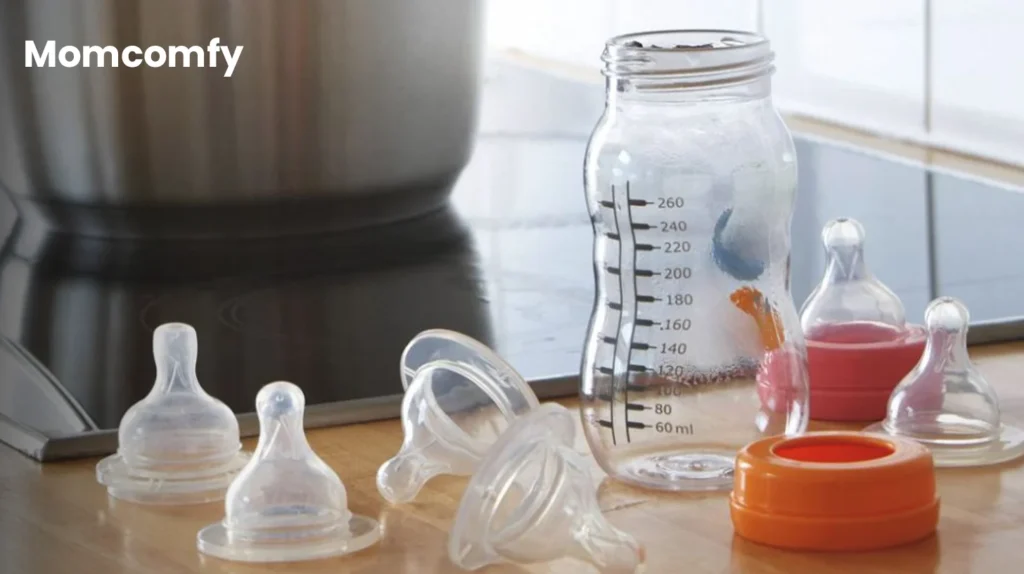
Sterilizing the bottle is only half the job. How you store it afterward matters just as much.
- Store sterilized bottles upside down on a clean, covered surface or inside the sterilizer with the lid on
- Never touch the inside of a sterilized bottle with bare hands handled only by the outside
- Assemble bottles only when you’re ready to use them
- If a bottle has been sitting open for more than 24 hours, re-sterilize it before use
- Keep the storage area clean and dry moisture encourages bacteria growth
Common Sterilizing Mistakes to Avoid
Even well-meaning moms make these slip-ups. Here’s what to watch for:
- Skipping the wash step sterilizing won’t remove milk residue; washing always comes first
- Not fully disassembling bacteria hide in valves, rings, and nipple grooves
- Touching the inside of bottles with bare hands after sterilizing
- Using cracked or worn bottles scratches trap bacteria that sterilizing can’t always reach
- Not drying properly damp bottles stored in enclosed spaces breed bacteria
- Reusing cold-water sterilizing solution past 24 hours
MomComfy Product Spotlight: The Bottle Sterilizer
When it comes to keeping your baby’s bottles safe and ready, the MomComfy Bottle Sterilizer has quickly become one of the most talked-about products in our community.
Fast cycles get through sterilization without keeping you waiting. Whisper-quiet won’t wake a sleeping baby during naptime cycles. Built-in drying feature bottles come out ready to use, no damp towels needed. Compact design fits neatly on most countertops without taking over your space. Fully enclosed steam cycle protects from recontamination after sterilizing.
“I was using the boiling method and it took forever. The MomComfy Sterilizer changed my whole routine. It’s so fast and the bottles are actually dry when it’s done. Game changer.”
— Jess, mom of 2, Texas
At $124.99 (down from $239.99), it’s a genuine investment in your daily peace of mind. MomComfy also offers free shipping on orders over $50 and a 30-day easy return policy.
What Modern Moms Are Choosing
The trend is clear: moms today are moving away from the stove-top boiling method and toward smart, electric solutions that save time and remove the guesswork from sterilization.
Here’s what’s trending right now:
- All-in-one sterilizer and dryer combos that eliminate the extra drying step
- Compact designs that don’t dominate kitchen counters
- UV sterilizers as an emerging tech option though steam remains the most widely recommended by pediatricians
- Travel-friendly microwave bags for moms always on the go
- Reminders to replace bottle nipples and worn parts regularly
The shift is toward simplicity, speed, and safety all in one place.
Sterilizing Tips for Specific Bottle Types
Glass Bottles safe for boiling and steam sterilizing. Avoid sudden temperature changes as thermal shock can crack glass. Always check for chips or cracks before use.
Plastic Bottles check for BPA-free and sterilizer-safe labels. Repeated boiling may warp plastic over time, so steam is the gentler option. Replace at the first sign of clouding or scratching.
Silicone Nipples are highly heat-resistant and safe for all methods. Inspect regularly for tears or thinning. Replace every 1 to 3 months even if they look fine.
Anti-Colic Bottles always fully disassemble, as valves are a common bacteria hiding spot. Clean valves with a small brush before sterilizing. Follow manufacturer instructions since valves vary by brand.
A Simple Daily Sterilizing Routine
Morning: Run a sterilizer cycle with bottles from the night before. Let dry completely before assembling.
After each feeding: Rinse the bottle immediately and add it to the washing queue.
Before bed: Start a sterilizer cycle so clean bottles are ready for overnight and morning feeds.
Once this becomes a habit, it takes maybe 5 minutes of active effort per day.
Conclusion
Learning how to sterilize baby bottles the right way is one of the best things you can do for your little one’s health and for your own peace of mind. Whether you go with boiling, steam, microwave, or cold-water sterilization, the most important thing is consistency.
Pick the method that fits your lifestyle, build it into your routine, and trust yourself. You are doing an amazing job.
And if you’re ready to make that routine even easier, the MomComfy Bottle Sterilizer is waiting for you fast, quiet, compact, and trusted by thousands of moms just like you.
Ready to simplify your bottle routine? Explore MomComfy’s full collection at momcomfy.store because clean bottles and a calm mom make for one very happy baby.
Frequently Asked Questions
How do I sterilize baby bottles for the first time?
Before using any new bottle, disassemble all parts and sterilize them using your preferred method of boiling, steam, or cold-water. This removes any manufacturing residue and ensures the bottle is safe from day one.
Do I need to sterilize baby bottles after every use?
For newborns under 3 months, yes sterilize after every use or at minimum once a day. As your baby gets older and their immune system strengthens, you can reduce frequency to every 1 to 2 days or a few times per week.
Can I sterilize baby bottles in a dishwasher?
A dishwasher can clean bottles thoroughly, but it doesn’t sterilize them in the medical sense. For true sterilization especially for newborns use boiling, steam, or a dedicated bottle sterilizer after dishwashing.
How long do sterilized bottles stay sterile?
If stored properly upside down, covered, in a clean dry space sterilized bottles typically remain sterile for up to 24 hours. If a bottle sits open or assembled longer than that, re-sterilize before use.
Is boiling or steam sterilizing better for baby bottles?
Both are effective. Boiling works well but can warp plastic over time and requires active supervision. Steam sterilizing is gentler on bottles, faster, and more convenient for daily use which is why it’s the preferred choice for most modern moms.