It’s 3 AM. Your baby is crying, your breasts are engorged, and you’re fumbling with a bra that feels like a tiny torture device. Sound familiar?
If you’ve been there or you’re preparing for that season of life you already know that the right nursing bra isn’t just a comfort item. It’s a survival tool.
One of the biggest decisions new moms face is choosing between a wireless nursing bra and an underwire nursing bra. Both have their fans. Both have their critics. And with so many options flooding the market, it’s easy to feel overwhelmed before you’ve even packed your hospital bag.
This guide is here to cut through the noise. We’ll walk you through everything you need to know what each type actually does, who they’re best for, and how to choose the one that fits your body and your life. And yes, we’ll share some real mom wisdom along the way.
Why Your Nursing Bra Choice Actually Matters
This isn’t just about comfort (though that matters enormously). The bra you wear while breastfeeding can affect:
- Milk flow: Tight underwires can put pressure on milk ducts, potentially contributing to blockages
- Latching ease: A bra with awkward clips or padding can make feeding in public stressful
- Postpartum recovery: Your body is changing rapidly; a rigid bra won’t adapt the way you need it to
- Sleep quality: Yes, some moms wear their bras at night. The wrong one makes that miserable.
Bottom line: this is one of those postpartum purchases worth getting right.
Understanding the Two Main Types
What Is a Wireless Nursing Bra?
A wireless nursing bra (also called a wire-free nursing bra or soft nursing bra) is exactly what it sounds like a breastfeeding bra with no underwire. Instead of rigid structure, it relies on stretch fabric, soft bands, and smart design to provide support.
Key features typically include:
- Soft, breathable fabric (often cotton, bamboo, or moisture-wicking blends)
- Stretchy, drop-down or pull-aside nursing cups
- One-handed nursing clips for easy, discreet feeding
- Seamless construction to reduce irritation
- Adapts to your changing breast size throughout the day
What Is an Underwire Nursing Bra?
An underwire nursing bra is a structured breastfeeding bra that uses a curved wire under each cup for lift and shape. It’s designed to look more like a traditional bra while still having nursing access.
Key features typically include:
- Rigid underwire for defined shape and lift
- Structured cups with nursing clasps
- More formal appearance better under fitted clothing
- Usually available in a wider range of cup sizes
- Feels closer to a pre-pregnancy bra experience
Wireless Nursing Bra: Deep Dive
Who It’s Best For
A wireless nursing bra is the go-to choice for most new moms, especially in the first 3-6 months postpartum. If any of the following sound like you, a wire-free option is probably your best bet:
- You’re breastfeeding frequently (every 2–3 hours = you need easy access, fast)
- Your breast size fluctuates throughout the day as milk comes in and out
- You want something comfortable enough to sleep in
- You have sensitive skin or postpartum tenderness
- You’re recovering from a C-section or still healing
Benefits You’ll Actually Feel
1. No pressure on milk ducts This is big. Many lactation consultants recommend avoiding underwires in early postpartum because sustained pressure on the breast tissue can contribute to clogged ducts or mastitis (a painful breast infection). A soft, wire-free bra gives your tissue room to breathe.
2. All-day and all-night comfort Many moms wear their nursing bras 24/7 especially when they’re leaking or pumping frequently. A wireless nursing bra is soft enough to sleep in without waking up feeling like you wrestled a coat hanger.
3. Grow with your changing body Your bra size can shift by one or even two cup sizes as your milk supply regulates. A stretchy, seamless wireless nursing bra adapts to those changes so you’re not buying a new bra every few weeks.
4. One-handed clips = total game changer You’ll often be holding a baby with one arm and trying to latch them with the other. One-handed nursing clips make this possible without an acrobatics degree.
💬 “I honestly wore my MomComfy wireless bra for like 20 hours a day in the first month. I didn’t even realize how much I needed it until I tried to go back to my old bra and nearly cried.” — Sarah M., MomComfy customer
Cons to Consider
- Less structured lift compared to underwire
- May not look as smooth under form-fitting tops
- Some cheaper versions lose their shape after washing
Underwire Nursing Bra: Deep Dive
Who It’s Best For
An underwire nursing bra makes more sense once breastfeeding is more established typically after 3-4 months or for moms who:
- Have a larger bust and feel unsupported without structure
- Are returning to work and need a more polished look
- Are nursing less frequently and want a more “normal” bra feel
- Have found a well-fitted underwire that doesn’t cause any pressure issues
Benefits Worth Knowing
1. More defined shape and lift If you’re heading back to the office or attending a wedding while still nursing, an underwire nursing bra gives you that polished silhouette without sacrificing nursing access.
2. Better for larger bust sizes Moms with a larger bust often find that wireless options don’t provide enough support for everyday activity. A well-fitted underwire can bridge that gap.
3. Familiar fit For moms who are used to underwire bras, the transition feels less jarring. It still has the structure and lift they’re accustomed to.
Cons to Consider
- Higher risk of clogged ducts if the wire sits on breast tissue incorrectly
- Less flexibility as breast size fluctuates
- Not ideal for nighttime wear
- Can feel uncomfortable during engorgement
- Requires a very precise fit harder to get right postpartum
Side-by-Side Comparison Table
| Feature | Wireless Nursing Bra | Underwire Nursing Bra |
| Support Style | Soft, stretchy fabric | Rigid underwire |
| Comfort Level | ⭐⭐⭐⭐⭐ | ⭐⭐⭐ |
| Milk Duct Safety | Low pressure risk | Risk if not fitted correctly |
| Adapts to size changes | Yes | Limited |
| Sleep-friendly | Yes | Not recommended |
| Appearance under clothes | Casual/soft | More structured/polished |
| Best timing | First 6 months+ | After 3–4 months postpartum |
| Nursing clip ease | One-handed | Usually one-handed |
| Price range | $ – $$ |
How to Choose the Right Nursing Bra: A Quick Buying Guide
Feeling clearer? Good. Now here’s how to narrow it down to your perfect match:
Consider Your Stage of Breastfeeding
- Newborn phase (0–3 months): Go wireless, always. Your body is still changing and you need comfort and flexibility above all.
- Established feeding (3+ months): You can try underwire if you want more structure just to make sure the fit is perfect.
Think About Your Daily Life
- Work from home / stay at home: Wireless nursing bra wins for all-day ease
- Back at the office: A structured nursing bra or a polished wireless option gives you professional confidence
- Night feeds: Wireless only something soft enough to sleep in
Know Your Fabric Needs
Look for:
- Breathable fabrics (cotton, bamboo, modal) especially if you run warm or live in a humid climate
- Moisture-wicking blends if you’re pumping often
- Seamless construction if you have sensitive or tender skin
Check the Clips
This sounds minor until you’re doing your 7th nursing session of the day. Look for:
- Smooth, snag-free clasps
- Easy one-handed operation
- Clips that don’t poke or pinch
Don’t Forget Size
Your ribcage and cup size both shift postpartum. Many moms find they need to go up a cup size (or two) while breastfeeding. Look for brands that offer size flexibility or stretchy cup construction.
MomComfy Nursing Bras: Built for Real Moms
If you’re looking for wireless nursing bras that check every box, MomComfy has become a go-to for over 10,000 moms and for good reason.
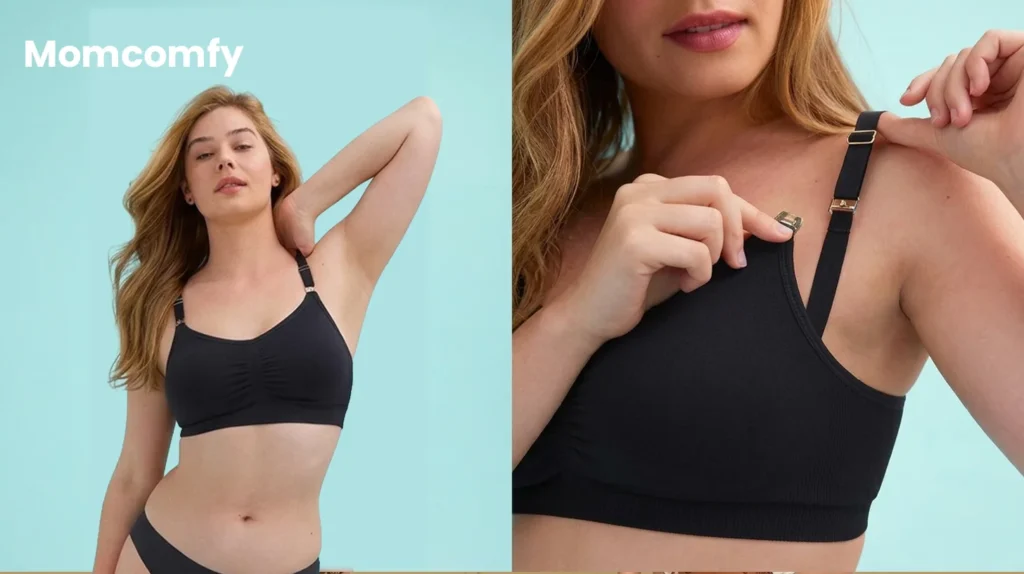
Their nursing bra collection includes four thoughtfully designed styles:
- Soft Lift Everyday: Your daily workhorse. Breathable, supportive, and simple.
- Night Softwrap: Designed for nighttime comfort and easy midnight feeds.
- Flexform Seamless: Seamless construction for zero irritation on sensitive skin.
- Featherfit Seamless: Ultra-lightweight for moms who want to forget they’re even wearing a bra.
All four styles are just $29.99 (originally $59.99), with free shipping on orders over $50 and a 30-day return policy. No risk, all comfort.
💬 “The Featherfit Seamless from MomComfy is genuinely the softest thing I’ve ever worn. I keep ordering backup pairs.” — Jessica R., verified buyer
Shop Now
What Real Moms Are Saying
We asked our MomComfy community what they wish they’d known before buying a nursing bra. Here’s what came up again and again:
- “Get more than one.” Your nursing bra will be washed frequently. Stock up on 3–4 so you’re never stuck.
- “Soft fabric is non-negotiable.” Scratchy materials feel 10x worse when your nipples are tender.
- “One-handed clips saved my sanity.” Especially with a squirmy newborn who won’t wait.
- “I didn’t know wireless could be so supportive.” Many moms assume wire-free = no support. Not true with the right brand.
- “I bought an underwire too early and regretted it.” Wait until your supply stabilizes before reaching for structure.
Emerging Trends: What Modern Moms Are Choosing
The postpartum fashion industry has come a long way. Here’s what’s trending in 2025 among breastfeeding moms:
1. Seamless, wireless everything The “barely there” movement is strong. Moms want bras that feel like a second skin, no seams, no wires, no fuss.
2. Bras that double as pump-friendly bras Wearable, wireless breast pumps (like the MomComfy Electric Breast Pump at $119.99) fit directly inside a supportive nursing bra with no tubes, no fuss. A hands-free pumping experience that fits into real life.
3. Neutral and inclusive sizing More brands are extending size ranges and offering neutral tones that don’t show through white shirts. MomComfy’s seamless range is designed to accommodate a wide range of body types as they change.
4. Sustainable fabrics Bamboo and organic cotton nursing bras are rising in popularity softer, more breathable, and gentler on sensitive postpartum skin.
Caring for Your Nursing Bras: Make Them Last
A good nursing bra is an investment. Here’s how to protect it:
- Wash in a mesh laundry bag on a gentle cycle
- Avoid the dryer heat breaks down elastic faster
- Hand wash when possible for the longest lifespan
- Rotate between 3-4 bras to reduce wear on each one
- Check clips regularly replace if they’re snagging or loosening
Conclusion: Comfort Is Non-Negotiable, Mama
Here’s the truth: most new moms don’t need an underwire nursing bra, at least not right away. What they need is something soft, supportive, easy to use at 3 AM, and kind to a body that’s doing something extraordinary.
A wireless nursing bra is almost always the smarter starting point. It adapts to you, protects your milk ducts, and makes breastfeeding less of a logistical challenge. Once your supply stabilizes and life finds a rhythm, you can always add a structured option to the mix.
But whatever you choose, choose comfort. You’re growing a human (or feeding one). You deserve to feel good doing it.
Ready to feel comfortable again? Explore MomComfy’s full collection of wireless nursing bras and postpartum essentials at Momcomfy trusted by 10,000+ moms, with free shipping over $50 and 30-day easy returns. Because you deserve comfort too.
Frequently Asked Questions
1. Is a wireless nursing bra supportive enough for larger busts?
Yes! as long as you choose the right style and size. Look for wireless nursing bras with a wide underband, firm side panels, and stretchy-but-structured cups. MomComfy’s Flexform Seamless and Soft Lift Everyday are both designed to offer real support without a wire.
2. Can I wear a nursing bra to sleep?
Absolutely! and many breastfeeding moms do, especially during the newborn stage when nighttime leaking is common. Always choose a wireless nursing bra for sleep. Underwire at night can restrict circulation and put pressure on milk ducts.
3. When should I start wearing a nursing bra during pregnancy?
Many moms start in the second or third trimester as their breasts begin to grow and regular bras become uncomfortable. A stretchy wireless nursing bra works perfectly as a maternity bra too.
4. How many nursing bras do I actually need?
Most lactation experts and moms recommend 3–5 nursing bras. This gives you enough rotation to wash them properly (air drying takes time!) without ever running out.
5. Can underwire cause mastitis or clogged ducts?
Underwire itself doesn’t cause mastitis, but a poorly fitted underwire that puts sustained pressure on breast tissue can contribute to blocked ducts, which can escalate to mastitis. This is why most lactation consultants recommend wireless options, especially in the first few months.
6. What’s the difference between a nursing bra and a pumping bra?
A nursing bra is designed for breastfeeding directly. A pumping bra has openings or is made from stretchy fabric that holds breast pump flanges in place. Many moms buy both or choose a hands-free pumping bra that doubles as a nursing bra. The MomComfy Electric Breast Pump is wearable and fits directly inside a supportive nursing bra.
7. Are seamless nursing bras better for sensitive skin?
Yes, in most cases. Seamless construction eliminates the raised stitching that can rub against already-tender nipple and breast tissue. If you’re experiencing postpartum skin sensitivity, MomComfy’s Featherfit Seamless or Flexform Seamless are excellent choices.