The pressure starts early. One person says six months is enough. Another insists you should nurse for years. Social media adds even more opinions. For many new parents, the biggest question becomes how long to breastfeed without feeling confused, judged, or overwhelmed.
Here is the truth: breastfeeding is not a one-size-fits-all journey. Research gives clear guidance, but your baby’s needs, your health, and your family situation also matter. The goal is not to follow someone else’s timeline. The goal is to understand what science says and make informed decisions with confidence.
Why the Question of Breastfeeding Duration Matters
Breastfeeding is more than feeding a baby. It supports growth, immunity, bonding, and maternal health. But the question of duration often creates stress because parents hear mixed messages.
Some parents stop earlier than planned because of work schedules, supply challenges, or exhaustion. Others continue longer and wonder whether they are doing the right thing.
The research offers reassuring clarity: there is no single “perfect” length of time that fits every family.
Instead, experts focus on the stages of feeding and the benefits associated with each.
What Research and Health Experts Recommend
When discussing how long to breastfeed, most research-backed recommendations follow a similar framework.
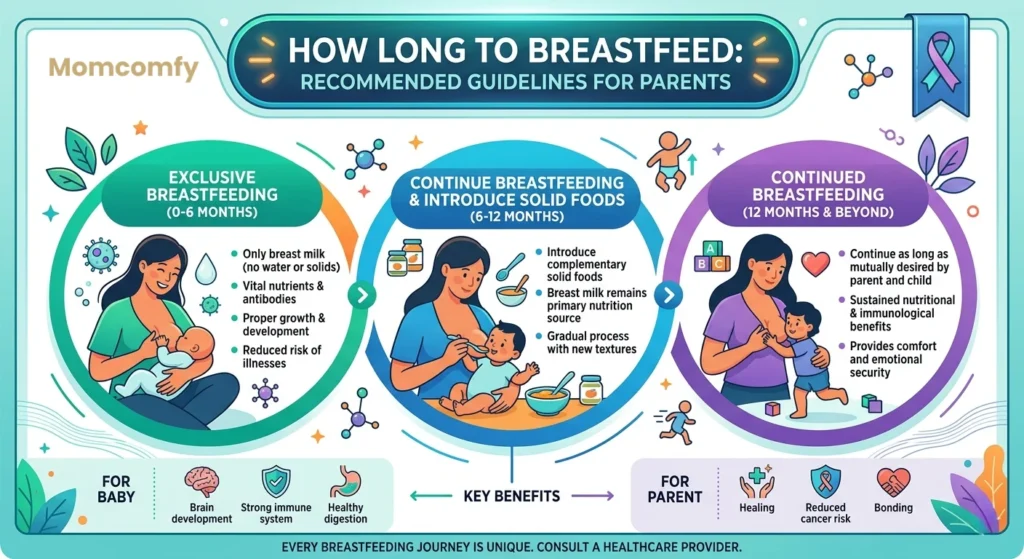
Major health organizations recommend:
- Exclusive breastfeeding for about the first six months
- Introduction of complementary foods around six months
- Continued breastfeeding alongside solids for at least one year
- Continued nursing beyond one year if the parent and child choose
These recommendations are based on decades of research examining infant nutrition, immune protection, and developmental outcomes.
Exclusive breastfeeding means:
- Breast milk provides primary nutrition
- No routine formula or solid foods
- Exceptions may include prescribed medications or vitamin supplements
This recommendation exists because breast milk changes over time to meet a baby’s developmental needs.
That said, recommendations are not rules designed to shame parents. They are evidence-based guidelines meant to support healthy development.
How Long to Breastfeed for Maximum Benefits
One of the most common questions parents ask is whether breastfeeding still matters after the early months.
The answer is yes.
Benefits During the First Six Months
The early months bring some of the strongest protective effects.
Research links breastfeeding during this stage with:
- Lower risk of gastrointestinal infections
- Reduced respiratory illnesses
- Better immune support
- Lower likelihood of ear infections
- Reduced hospitalization risk in some infants
Breast milk also contains antibodies and immune factors that adapt to a baby’s environment.
For mothers, breastfeeding may support:
- Faster uterine recovery after birth
- Reduced postpartum bleeding
- Lower risk of certain breast and ovarian cancers
- Calorie use that may support postpartum recovery
These benefits explain why experts emphasize exclusive breastfeeding early on.
Benefits Beyond Six Months
Many parents assume breastfeeding becomes nutritionally irrelevant after solids begin.
Research does not support that belief.
After six months:
- Breast milk still provides nutrients
- Immune support continues
- Emotional regulation and comfort remain important
- Nursing may help during illness or teething
Breast milk continues to contain fat, protein, and protective compounds even as solid foods increase.
This is why discussions about how long to breastfeed should not stop at six months alone.
Benefits After One Year
Extended breastfeeding remains misunderstood.
Yet research shows continued nursing can still provide:
- Nutritional support
- Comfort during developmental transitions
- Immune benefits
- Emotional security
Milk composition changes over time and remains biologically valuable.
Breastfeeding after one year is not “spoiling” a child. It is simply one feeding and bonding choice among many.
How Long Do I Breastfeed a Newborn? Understanding the Early Weeks
Many parents search for how long to breastfeed a newborn and for a breastfeeding schedule because the first weeks feel unpredictable.
That feeling is normal.
Newborn feeding rarely follows a strict clock.
What to Expect in the First Days
Newborn stomachs are tiny.
During the first days, babies often nurse:
- 8–12 times per 24 hours
- Sometimes more during cluster feeding
- For varying lengths of time
Some feeds last:
- 10 minutes
- 20 minutes
- 40 minutes or longer
Time alone does not determine whether a feed is effective.
Instead, watch for:
- Audible swallowing
- Relaxed hands after feeding
- Adequate wet diapers
- Weight gain
- Contentment after many feeds
Early feeding patterns can feel relentless, but frequent nursing helps establish supply.
How Long Should Each Breastfeeding Session Last?
Parents often confuse how long to breastfeed overall with how long each session should last.
These are different questions.
There is no universal feeding duration.
Some babies:
- Feed efficiently in 10–15 minutes
- Nurse longer for comfort and nutrition
- Switch sides naturally
- Develop different patterns over time
Rather than watching the clock, focus on baby-led cues.
Signs baby is still feeding effectively:
- Rhythmic sucking
- Swallowing sounds
- Continued active feeding
Signs of feeding may be finished:
- Slowed sucking
- Release of the breast
- Relaxed posture
- Sleepiness after effective feeding
Rigid timing rules can create unnecessary stress.
How Long Do I Breastfeed a Newborn, Breastfeeding Schedule, and Feeding Cues
Many parents want a predictable routine immediately.
A breastfeeding schedule sounds reassuring, but newborns usually feed on demand rather than on strict intervals.
Hunger Cues Matter More Than the Clock
Early hunger signs include:
- Rooting
- Hand-to-mouth movements
- Lip smacking
- Increased alertness
Late hunger signs:
- Crying
- Fussiness
- Distress
Responding to early cues often makes feeding easier.
Cluster Feeding Is Normal
Cluster feeding causes major anxiety.
A baby may suddenly nurse:
- Every hour
- Repeatedly in the evenings
- For several days
Parents sometimes worry that this means:
- Low supply
- Poor milk quality
- Hunger is not being satisfied
In reality, cluster feeding is often a normal growth-related behavior.
It stimulates milk production and supports development.
A realistic breastfeeding schedule during early infancy is flexible rather than perfectly timed.
A Real-World Example: Two Different Breastfeeding Journeys
Experience matters when discussing breastfeeding.
Consider these two common scenarios.
Parent A
Sarah planned to breastfeed for one year.
After returning to work at four months, pumping became difficult. She continued mixed feeding and breastfed mornings and evenings until eight months.
She worried she had failed.
Research says otherwise.
Her baby still received meaningful benefits from breast milk.
Parent B
Maria breastfed for two years.
Her toddler nursed mostly:
- Before naps
- Bedtime
- During illness
Family members questioned her choice.
But continued nursing worked for both parent and child.
These examples show an important truth:
Successful breastfeeding looks different in different families.
When Breastfeeding Does Not Go as Planned
Discussions about how long to breastfeed should include honesty.
Breastfeeding is natural, but it is not always easy.
Challenges may include:
- Latch problems
- Low milk supply
- Pain
- Mastitis
- Tongue tie
- Mental exhaustion
- Work-related barriers
Parents often feel guilt when nursing becomes difficult.
That guilt helps no one.
Feeding decisions should support:
- Baby’s nutrition
- Parent’s wellbeing
- Family sustainability
Sometimes breastfeeding continues with support.
Sometimes combination feeding works best.
Sometimes weaning becomes the healthiest option.
A supported parent is essential for a healthy baby.
Signs It May Be Time to Wean
Research provides guidance, but personal readiness matters too.
Weaning may happen because:
- Parent feels ready
- Baby self-weans
- Work demands increase
- Medical reasons arise
- Feeding goals change
Signs a child may naturally reduce nursing:
- Greater interest in solids
- Shorter feeds
- Increased independence
- Skipped sessions
Gentle weaning often works best.
Helpful strategies include:
- Dropping one feed at a time
- Offering comfort in other ways
- Maintaining routines
- Avoiding abrupt changes when possible
Weaning is not failure.
It is simply another stage of parenting.
Common Breastfeeding Myths That Create Confusion
Misinformation makes parents second-guess themselves.
Let’s clear up a few myths.
Myth 1: Breastfeeding Stops Being Useful After Six Months
False.
Breast milk continues to provide nutrition and immune support.
Myth 2: Longer Breastfeeding Creates Dependency
Research does not support this claim.
Secure attachment and independence can coexist.
Myth 3: Formula Use Means Breastfeeding Failed
False.
Combination feeding can still provide benefits.
Myth 4: Babies Should Feed on Strict Timetables
Early infancy rarely follows perfect scheduling.
A flexible breastfeeding schedule often works better.
How to Decide What Is Right for Your Family
If you are still wondering how long to breastfeed, start with these questions:
- Is breastfeeding working physically?
- Is it sustainable emotionally?
- Is the baby growing well?
- Does continuing or weaning feel right for your family?
Research provides guidance.
Your lived reality provides context.
Both matter.
Parenting decisions work best when informed rather than pressured.
Conclusion: Breastfeeding Is a Journey, Not a Competition
The conversation around how long to breastfeed often becomes unnecessarily rigid. Research supports exclusive breastfeeding for about six months and continued nursing alongside solids for at least a year and beyond if desired. But science also recognizes individual circumstances.
Whether you are asking how long to breastfeed a newborn, breastfeeding schedule questions during sleepless nights or considering toddler nursing, remember this: feeding success is not measured by comparison.
The best breastfeeding journey is one that nourishes both baby and parent.
FAQs About Breastfeeding Duration
1. How long should you breastfeed a baby?
Research-based guidance recommends exclusive breastfeeding for about six months and continued breastfeeding alongside solid foods for at least one year. Many families continue longer if breastfeeding remains comfortable and beneficial for both parent and child. The answer to how long to breastfeed depends on your baby’s needs and your family situation.
2. How long do I breastfeed a newborn?
Parents searching for how long to breastfeed a newborn often expect a fixed answer, but newborn feeding varies. Most newborns nurse 8–12 times within 24 hours during the early weeks. Feeding should usually follow hunger cues rather than a strict clock.
3. Is breastfeeding after one year still beneficial?
Yes. Breastfeeding after one year still offers nutritional value, immune support, and emotional comfort. Breast milk continues to adapt over time and can remain a meaningful part of a child’s diet and bonding experience.
4. What is a good breastfeeding schedule for newborns?
A newborn breastfeeding schedule is usually flexible rather than rigid. Babies commonly feed every 2–3 hours, though cluster feeding and growth spurts may lead to more frequent nursing. Watching hunger cues is often more effective than relying only on time intervals.
5. Is it okay to stop breastfeeding before one year?
Yes. While research highlights the benefits of longer breastfeeding, feeding decisions must consider parental well-being, medical needs, milk supply, and family circumstances. If breastfeeding ends earlier than planned, your baby can still grow and thrive with proper nutrition and support. The most important factor is ensuring your baby is fed and cared for consistently.