Here is something the hospital discharge paperwork never mentions: your body will feel like a stranger’s for a while after delivery, and your bra drawer will be the first place that makes that obvious.
Bras that fit through your third trimester will not fit now. The ones you wore two years ago are even further off. And buying anything based on guesswork during those early postpartum weeks usually means spending money on bras that stop working within a month.
This nursing bra size guide skips the fluff and gets straight to what you actually need: a clear method for measuring yourself at home.
Your Postpartum Body Has Its Own Sizing Rules
Clothing sizes are already inconsistent across brands. Bra sizing adds another layer of complexity. And nursing bra sizing? It operates by a completely different logic than anything you have dealt with before.
Here is why.
Milk production creates internal pressure inside breast tissue. That pressure rises before a feed and drops after one. It peaks during growth spurts and dips when your baby starts eating solid food. This means your breasts are not a fixed size on any given day they shift between morning and evening, and between feeding sessions.
A standard bra is built around the assumption that what goes in stays the same. A nursing bra has to accommodate a body that is actively changing hour by hour.
Getting your measurements right does not just affect comfort it affects supply. A band that cuts into your rib cage or a cup that compresses glandular tissue can slow milk drainage. Slow drainage leads to clogged ducts. Clogged ducts lead to mastitis. The right fit protects all of that.
This nursing bra size guide treats measurement as a health decision because for nursing mothers, it genuinely is one.
The Postpartum Size Timeline Nobody Talks About
Most sizing guides tell you to measure yourself and then shop. What they skip over is when to measure and that timing changes everything.
The first ten days: Your body is flooding with prolactin, the hormone that triggers milk production, and your breast tissue responds dramatically. Engorgement during this window can make your chest feel rock-solid and look several sizes larger than it will stabilize at. Any bra you buy right now is a temporary solution, not a wardrobe investment.
Weeks three through five: The initial engorgement has passed, but your supply is still calibrating to your baby’s feeding pattern. Sizing during this window is more accurate than week one, but still not fully settled.
Weeks six to eight: This is your measurement window. By this point, your body has established a rhythm. Your supply is responding to demand, not flooding at random. The size you measure now will be the most consistent size you carry through the bulk of your nursing months.
Every eight weeks after that: Feeding frequency changes as your baby grows. Fewer feeds mean less constant stimulation, which changes breast fullness patterns. Re-measuring at regular intervals keeps your bras working correctly instead of slowly becoming the wrong fit.
Four Things to Have Ready Before You Measure
No special equipment required.
- A soft fabric tape measures the kind used for sewing. Hardware store tape measures are rigid and cannot follow body curves correctly.
- A non-padded bra or nothing at all padding adds false volume and shifts both your band and bust numbers.
- Good lighting and a full-length mirror need to confirm the tape is level at the back, and you cannot do that by feeling alone.
- Something to write with does not rely on memory. Two numbers, written down immediately, save a lot of confusion at checkout.
The Complete Measurement Process for Nursing Moms
This is the core of every accurate nursing bra size guide: the step-by-step method that gets your numbers right the first time.
Step One: The Band Measurement
Stand with your feet hip-width apart, shoulders relaxed, breathing normally. Bring the tape around your torso and position it directly under your breasts, where the bra band sits when you are wearing one.
The tape should feel like a firm handshake present, but not squeezing. If you can pull it more than an inch away from your body, tighten it slightly. If it makes you hold your breath, loosen it.
Read the number where the tape meets itself and write it down.
- Even result: Your band size is that number exactly.
- Odd result: Add one to make it even. That is your band size.
Step Two: The Bust Measurement
Keeping the same posture, bring the tape up to the fullest part of your chest. For most women, this sits across the center of the breast, roughly at nipple height. Let the tape rest naturally against the skin not pressed in, not sagging away.
Write this number down next to the first.
Step Three: The Cup Calculation
Subtract your band number from your bust number. The result is a gap, and that gap translates to a cup letter using the table below:
| Gap Between Measurements | Cup Letter |
| 1 inch | A |
| 2 inches | B |
| 3 inches | C |
| 4 inches | D |
| 5 inches | DD |
| 6 inches | DDD / F |
| 7 inches | G |
| 8 inches | H |
Work example: Band = 36. Bust = 41. Gap = 5. Cup = DD. Starting size = 36DD.
Step Four: The Nursing Adjustment
Here is the piece that turns a standard size into a nursing size.
When you are full of milk before a feed, your breasts are physically larger than they are an hour after nursing. If your bra fits perfectly at the empty point, it will feel punishing when you are full. If it fits at the full point, it sags and bunches after a feed.
The solution used by lactation consultants and professional fitters is to purchase one cup size above your calculated result. Your body fills into it when full and the extra room disappears when you are not. The bra works correctly at both ends.
So: calculated 36DD becomes a 36DDD in the nursing bra you actually purchase.
The band size stays the same. Only the cup adjusts.
Checking the Fit Once the Bra Arrives
Numbers get you close. The fit check confirms you are there.
What a correct band feels like: Put the bra on fastened at the loosest set of hooks. Now reach around and pull the band straight back. It should resist, not stretch easily away. If it lifts off your body or rides up toward your shoulders when you raise your arms, go one band size smaller. If breathing feels restricted or you see marks forming within ten minutes of wearing, go one band size up.
What correct cups look like: Every part of the breast sits inside the cup without overflow at the top, pressure at the sides, or puckering in the fabric. If the cup wrinkles inward, the cup is larger than needed. If breast tissue spills over the top edge or bulges at the sides, the cup is too small.
Where the underwire should sit and where it should not: An underwire nursing bra should trace the natural perimeter of the breast and land on bone, not tissue. Run your finger along the wire path. The moment you feel it pressing on soft breast flesh rather than your rib cage, that bra is the wrong shape or size for your body. This matters particularly during nursing because sustained pressure on glandular tissue is a direct contributor to duct blockage.
The nursing clasp test: Open and close the nursing clip or drop-down cup with one hand only. Practice with your non-dominant hand. You will be doing this while holding a baby, in the dark, half asleep, while also trying to position a latch. If the mechanism needs two hands or real concentration to work, it will frustrate you daily. Try a different closure design.
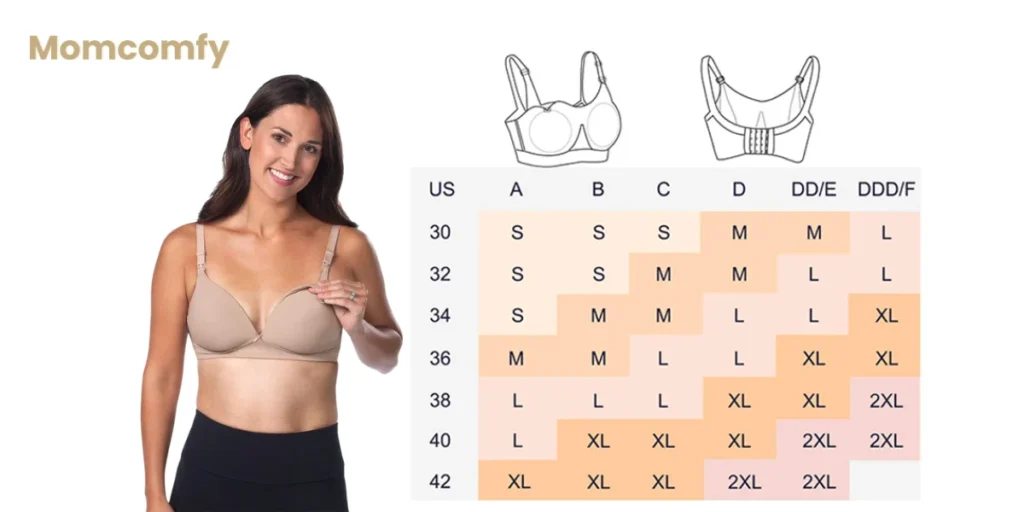
Nursing Bra Styles and Who They Actually Suit
A nursing bra size guide is only half the picture. The other half is knowing which style fits your life.
Wire-Free Full-Support Bras
These are engineered with wide underbands, structured side panels, and internal support slings that lift without an underwire. They suit any nursing mother but are especially important in the first eight postpartum weeks when breast tissue is sensitive and milk flow is still being established.
Modern wire-free nursing bras are not the shapeless, faded beige options of a decade ago. Many now offer real structure, lined cups, and enough support for women with larger cup sizes.
Underwire Nursing Bras
The right underwire bra at the right time is genuinely useful especially for women in the D cup range and above who need structured support for physical activity or long work days.
The timing rule: wait until your milk supply has settled into a predictable pattern, typically after the eight-week mark. After that point, underwire is not harmful as long as the fit is accurate and the wire does not contact breast tissue.
Get professionally fitted for underwire nursing bras. The margin for error is narrower than with wire-free styles.
Bralettes and Sleep Nursing Bras
Built for overnight feeds and recovery days. These are not structured support pieces; they are low-pressure, breathable options for the hours when your body needs to move freely. Look for moisture-wicking fabrics if night sweats are an issue (common in early postpartum), and drop-down cups that function without you having to fully wake up.
Pumping Bras
If you pump whether occasionally or exclusively a dedicated pumping bra changes the entire experience. These have built-in openings that hold pump flanges in place and leave your hands completely free.
Sizing follows the same method outlined in this nursing bra size guide, but pay close attention to where the flange openings fall on your specific chest shape. The opening must center on the nipple without pulling surrounding tissue toward the flange during use.
Nadia’s Situation: A Sizing Story Worth Reading
Nadia came home from the hospital with twins and immediately discovered that nothing in her maternity bra collection was going to work anymore. She was nursing both babies, pumping to build a freezer stash, and dealing with a level of engorgement she had not been warned about.
She had been wearing a 34C throughout pregnancy. After trying to force herself back into those bras for two weeks, she measured herself using the steps in this nursing bra size guide: band came out at 36, bust came out at 43. That is a seven-inch difference from a G cup. Adding the nursing cup, she was looking for a 36H.
The challenge was that she had been searching the 34C section of every store she visited. Once she measured correctly, she found bras immediately and wore them comfortably for the next ten months of nursing.
Her cup size was not the problem. The measurement was.
When Home Measurement Is Not Enough
Self-measuring at home handles the majority of situations well. These are the cases where a professional fitting adds real value:
Cup size at G or above: The fit variables compound significantly at larger cup sizes, and a trained fitter can identify issues with shape and placement that a tape measure cannot.
Breast asymmetry: Most women have some difference in size between their two breasts. Postpartum, that difference is often more pronounced. Fit to the larger side and use a removable pad on the smaller side to balance the silhouette if needed.
Recurring physical symptoms: If you experience repeated blockages, persistent shoulder tension, or strap indentations that do not fade within thirty minutes of removing your bra, the fit has a specific problem that a fitter can identify and correct.
You have re-measured twice and still cannot find comfort: At that point, an in-person fitting removes all guesswork and gets you to a solution faster than continued trial and error.
Postpartum Re-Measure Schedule
| Time Since Delivery | What to Do |
| Week 1–2 | Wear temporary comfort options. Do not size investment bras. |
| Week 6–8 | Full measurement. Main bra wardrobe purchase. |
| Month 3 | Re-check if the feeding schedule has changed significantly. |
| Month 5–6 | Re-measure when solid foods enter the picture. |
| Weaning | Final re-measure. Breast tissue and shape will shift again. |
Nursing Bra Size Quick Reference
| Band | Bust | Gap | Calculated Cup | Buy This Nursing Size |
| 32 | 34 | 2 | B | 32C |
| 34 | 37 | 3 | C | 34D |
| 36 | 40 | 4 | D | 36DD |
| 36 | 41 | 5 | DD | 36DDD |
| 38 | 44 | 6 | DDD | 38G |
| 40 | 47 | 7 | G | 40H |
The band stays as measured. Cup size goes one letter up from the calculated result.
Closing: Fit Is Not a Comfort Preference It Is a Nursing Tool
A nursing bra that fits correctly does things an ill-fitting one simply cannot: it supports milk flow, distributes weight properly so your back and shoulders carry the load correctly, and lets you feed your baby without wrestling with your clothing.
This nursing bra size guide gives you everything to make that happen without a fitting room, a specialist, or expensive trial and error. Measure at six to eight weeks. Apply the nursing cup adjustment. Check the fit against your body, not just the label. Re-measure when your feeding pattern changes.
You are doing one of the most physically demanding things a human body does. The bra you wear every day deserves the same attention as everything else you have prepared for this season.
Tape measure out. Measurement done. Better bra on the way.